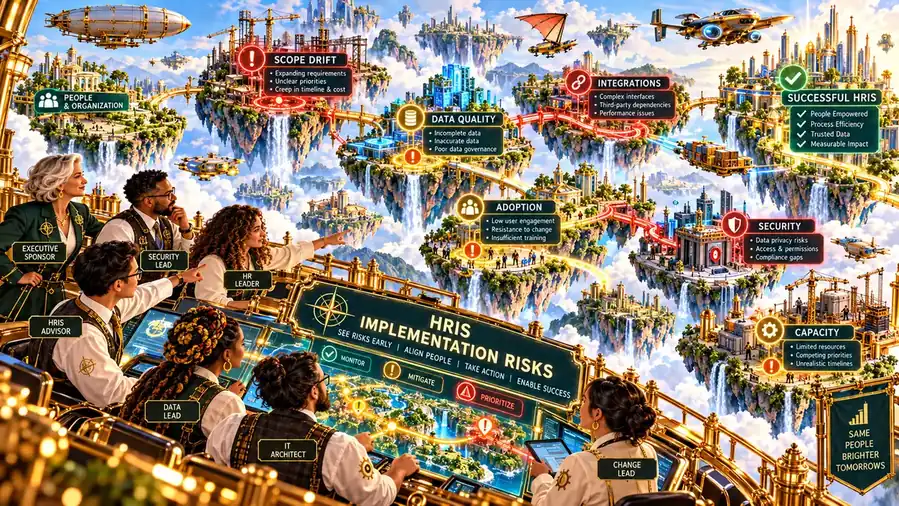
The most visible HRIS implementation problems usually appear late.
The underlying risks often begin much earlier.
A missed test case appears during UAT, but the real issue may be that nobody owned the process exception.
A broken payroll interface appears near go-live, but the real issue may be that integration ownership was unclear six months earlier.
A project appears to be behind schedule, but the real issue may be that the organization never had enough internal capacity to meet the original plan.
This is why implementation risk should be managed before configuration begins.
Risk 1: unclear scope
When scope is unclear, every workshop can become a scope discussion.
Typical symptoms include:
- modules described differently by different stakeholders
- local processes added late
- “small” integrations appearing after design
- historical data requirements expanding
- reports treated as post-go-live until executives ask for them
The control is simple in principle: define what is in, what is out, what is phased and who can approve a change.
Without that, the project has no stable boundary.
Risk 2: unclear decision rights
HRIS implementations contain hundreds of decisions.
If the project knows who attends a workshop but not who can decide, it will slow down.
Common examples:
- global HR versus local HR
- HR versus IT
- payroll versus HRIS
- security versus process owner
- project team versus steering committee
A decision model should state:
- owner
- decision authority
- escalation path
- deadline
- consequences of delay
This turns “waiting for alignment” into a visible project risk.
Risk 3: weak source data
Data risk is rarely only about missing values.
It includes:
- inconsistent definitions
- duplicate records
- obsolete codes
- local workarounds
- unclear history
- unsupported structures
- fields that nobody actually owns
A migration can load technically and still create operational problems.
The control is to assign business ownership to data cleansing, transformation and reconciliation.
Risk 4: integration scope is discovered too late
Integrations are often underestimated because they are described at a high level.
“Integrate payroll” can hide many decisions:
- which data
- which direction
- how often
- which effective dates
- which error handling
- who owns reconciliation
- what happens during failure
- how security works
- what downstream systems depend on the feed
The earlier the interface is treated as an operational process rather than an API connection, the lower the risk.
Risk 5: the internal team does not have enough capacity
Vendor plans usually show vendor effort clearly.
Customer effort is often implied.
The internal team may need to provide:
- process decisions
- data preparation
- testing
- security review
- integration support
- communications
- training
- reporting requirements
- change management
- go-live support
If those people are also running daily operations, the plan needs to account for that.
Capacity risk is a planning issue, not a personal-productivity issue.
Risk 6: security is treated as a late technical task
Security design affects:
- what users can see
- what managers can approve
- which HR populations are visible
- how sensitive data is protected
- who can make changes
- how integrations authenticate
Late security changes can force redesign across workflows, testing and support.
Define the role model early and test it with realistic user populations.
Risk 7: testing starts with scripts instead of operating scenarios
A test script can prove that a field accepts a value.
It does not prove that the business can operate.
Testing should include:
- normal cases
- exceptions
- retroactive changes
- multiple roles
- rehires
- transfers
- manager changes
- failed interfaces
- approval changes
- data loads
- downstream reporting
The project should test the real operating model, not only configuration units.
Risk 8: the vendor becomes the de facto decision maker
A good implementation partner should recommend.
The customer must still decide.
When internal ownership is weak, vendor suggestions can quietly become organizational policy.
This creates risk because the recommendation may optimize:
- implementation speed
- standard product design
- consultant effort
- local workstream simplicity
rather than the customer’s long-term operating model.
Customer-side ownership protects the difference.
Risk 9: the project plan looks healthy because decisions are invisible
Many status reports track tasks, not unresolved decisions.
That can hide risk.
A project may show “design workshop complete” while key questions remain open.
Track:
- decisions
- assumptions
- dependencies
- scope changes
- unresolved risks
- owners
- dates
A green task is not the same as a resolved issue.
Risk 10: go-live is treated as a date instead of a readiness decision
A planned date creates momentum.
That is useful until it becomes stronger than the evidence.
Go-live readiness should include objective gates such as:
- critical defects closed
- data reconciled
- integrations stable
- permissions validated
- support active
- administrators trained
- business sign-off complete
- contingency agreed
If the organization cannot explain why it is ready, the date is not enough.
Risk 11: post-go-live ownership is undefined
Some implementations succeed technically and fail operationally because nobody planned what happens next.
Questions include:
- Who supports users?
- Who owns configuration?
- Who manages releases?
- Who monitors integrations?
- Who handles data quality?
- Who prioritizes enhancements?
- How much vendor support remains?
The target operating model should be part of implementation design.
Risk is often the absence of a decision
HRIS projects are not uniquely risky because the technology is complicated.
They are risky because technology, process, people, data and ownership all change together.
The strongest risk control is therefore not a longer risk register.
It is a project model that makes scope, ownership, decisions, dependencies and readiness explicit early enough to act on them.