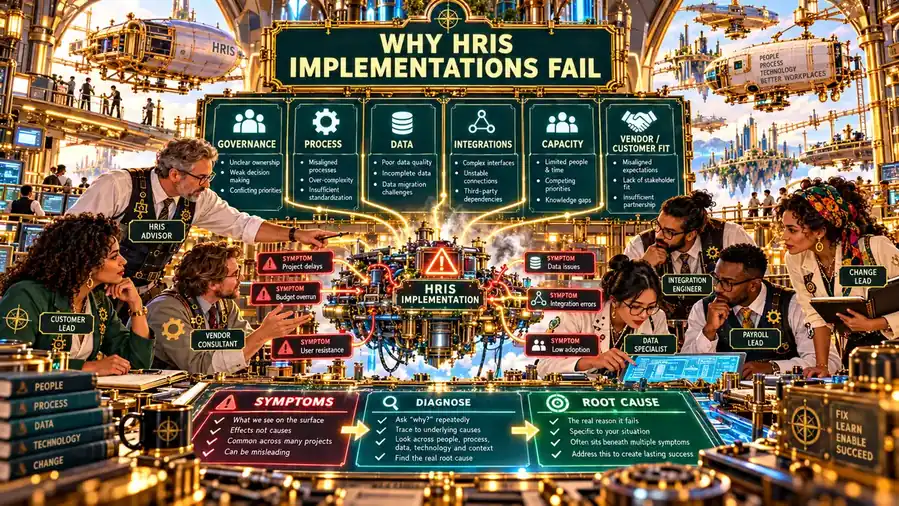
A failed HRIS implementation rarely fails in one clean way.
The system may technically be live while the organization is still operating through spreadsheets.
The project may be “on track” while key integrations are unstable.
Users may blame the platform when the real problem is process design.
The implementation partner may be blamed when the customer has never made the decisions the partner needs.
That is why recovery starts with diagnosis.
First, define what “failed” means
Failure can mean very different things.
Examples include:
- missed go-live
- unstable payroll
- data-quality problems
- low adoption
- excessive manual work
- unusable reporting
- broken integrations
- uncontrolled backlog
- high consultant dependency
- cost overrun
- repeated redesign
- no confidence in the project team
The first step is to describe the observable operating impact.
Avoid starting with “the system is bad” or “the vendor failed.”
Those may become conclusions. They should not be the diagnosis.
Separate symptoms from causes
Consider a common symptom: managers are not using the system.
Possible causes include:
- poor user experience
- permissions
- bad training
- process complexity
- unclear accountability
- missing data
- workflow design
- lack of executive reinforcement
- a process that never made sense in the first place
The same symptom can require completely different interventions.
A recovery plan built around the wrong cause creates more work.
Failure mode 1: configuration is wrong
Sometimes the problem really is configuration.
Examples:
- approvals do not reflect policy
- roles are too broad or too restrictive
- business rules are inconsistent
- workflows create unnecessary steps
- fields or structures are poorly designed
The fix may be contained if the surrounding process and ownership are sound.
But configuration changes should still be tested against the intended operating model.
Failure mode 2: the process is wrong
The system may be implementing a process that was never agreed properly.
This often appears as:
- excessive exceptions
- local workarounds
- approvals that nobody understands
- duplicate steps
- manual reconciliation
- constant requests to “make the system more flexible”
The solution may require process redesign before configuration changes.
Failure mode 3: the data cannot support the process
Poor data can make a good design look broken.
Examples:
- missing manager relationships
- inconsistent organizational structures
- obsolete job codes
- duplicate employees
- unreliable effective dates
- local values that do not map cleanly
Data correction may need both immediate cleanup and longer-term governance.
Failure mode 4: integrations are unstable
A core HRIS may work correctly while the operating environment fails around it.
Typical issues include:
- timing mismatches
- missing error handling
- ownership gaps
- duplicate feeds
- unclear system-of-record rules
- manual recovery steps
- no monitoring
An integration rescue should address the operational model, not only the interface code.
Failure mode 5: nobody owns the platform
A live HRIS needs ownership.
Without it, the organization often sees:
- uncontrolled changes
- growing backlog
- vendor dependency
- inconsistent support
- weak release management
- unclear data ownership
- repeated decisions
The system becomes harder to operate even if the original implementation was technically sound.
Failure mode 6: the project governance is broken
A project can stall because decisions do not move.
Symptoms include:
- the same issue appears in multiple meetings
- nobody can approve scope changes
- steering meetings review status but make no decisions
- risks have no owner
- vendor escalations remain unresolved
- dates move without consequences being discussed
The recovery action may be a governance reset rather than more project management.
Failure mode 7: internal capacity was unrealistic
Some projects depend on people who were never actually available.
This creates:
- late decisions
- weak testing
- rushed data work
- incomplete training
- slow defect resolution
- dependence on consultants
A rescue plan should re-estimate customer-side capacity honestly.
Failure mode 8: the implementation partner and customer are optimizing for different things
An implementation partner may optimize for:
- standard product
- agreed scope
- delivery efficiency
- billable work structure
The customer needs to optimize for:
- long-term operations
- adoption
- sustainable ownership
- business outcomes
- total cost
- cross-system reality
Neither perspective is inherently wrong.
Failure occurs when nobody manages the gap.
Stabilize before redesigning
When a project is in trouble, teams often try to fix everything.
That is dangerous.
A better recovery sequence is:
1. Protect critical operations
Identify risks to:
- payroll
- compliance
- employee data
- access
- critical integrations
- business continuity
2. Freeze unnecessary change
Reduce noise while the root causes are assessed.
3. Build a fact base
Document:
- open defects
- unresolved decisions
- integration status
- data issues
- scope gaps
- capacity constraints
- vendor commitments
4. Separate immediate fixes from structural redesign
Not every problem belongs in the emergency plan.
5. Reset governance
Make ownership and decision rights explicit.
Decide whether the current plan is still credible
Recovery sometimes requires a difficult question:
Is the existing implementation plan still the right plan?
Possible answers include:
- yes, with tighter control
- yes, but with reduced scope
- yes, with a later date
- only after stabilization
- no, a redesign is required
- no, the platform decision itself must be revisited
Avoid protecting a plan simply because a lot has already been invested in it.
A failed implementation can still produce useful evidence
Troubled projects reveal the organization’s real constraints.
They show:
- where ownership is weak
- which processes are unresolved
- where data is unreliable
- which integrations are critical
- what the internal team can support
- where vendor assumptions do not fit
That evidence should shape the recovery.
The goal is not to return to the original plan.
It is to create a plan that reflects what the organization now knows.